Born in wartime, shaped by silver, and still unlike every other Indian banknote.
At first glance, India's ₹1 note seems almost insignificant. Its face value is tiny, and today it is encountered far less often than a one-rupee coin. Yet this modest piece of paper carries one of the most unusual stories in Indian monetary history.
It was born because of the First World War, disappeared when the economics changed, returned during the Second World War, survived Independence, vanished again for more than two decades, and then came back in the twenty-first century.
Most remarkably, it is the only Indian currency note issued by the Government of India rather than the Reserve Bank of India — and therefore it does not carry the signature of the RBI Governor.
When One Rupee Was Silver
Before the paper ₹1 note existed, the rupee was closely associated with silver. The one-rupee silver coin was a familiar and important part of everyday commerce in British India.
Then came the First World War. Wartime conditions put pressure on metals and on the economics of producing silver coinage. British India needed another way to keep the one-rupee denomination circulating.
The solution was simple, practical and historically important: the silver rupee was turned into paper.
1917 — A World War Gives Birth to the ₹1 Note
On 30 November 1917, the Government of India introduced the first ₹1 paper note. It carried the portrait of King George V. The Reserve Bank of India did not yet exist; it would only begin operations in 1935.
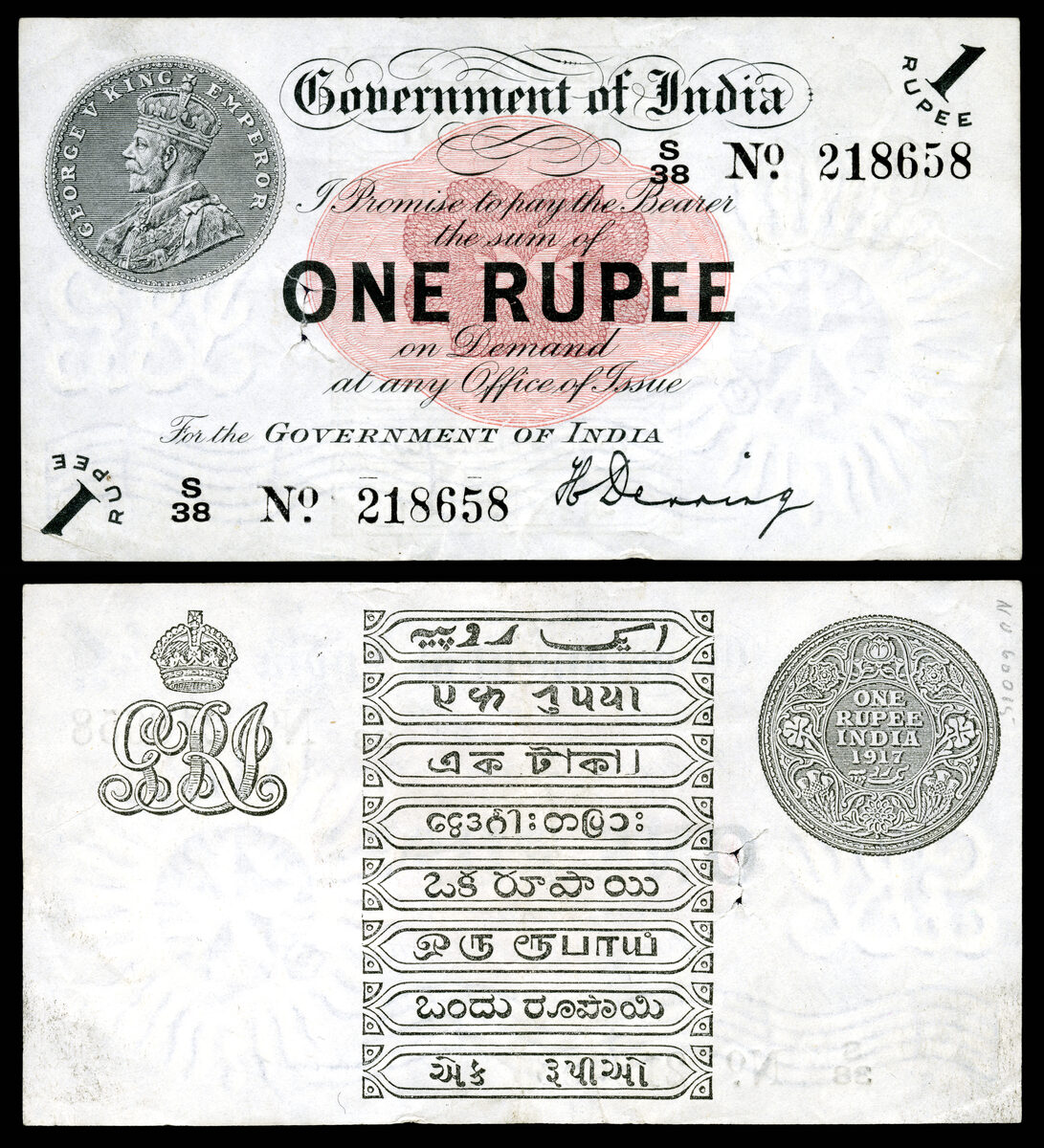
Even within this first series, the signatory could vary. A note from the same 1917–1930 issue carries a different signature — a reminder that "the 1917 note" was never a single fixed design, but a run that changed hands as officials changed.
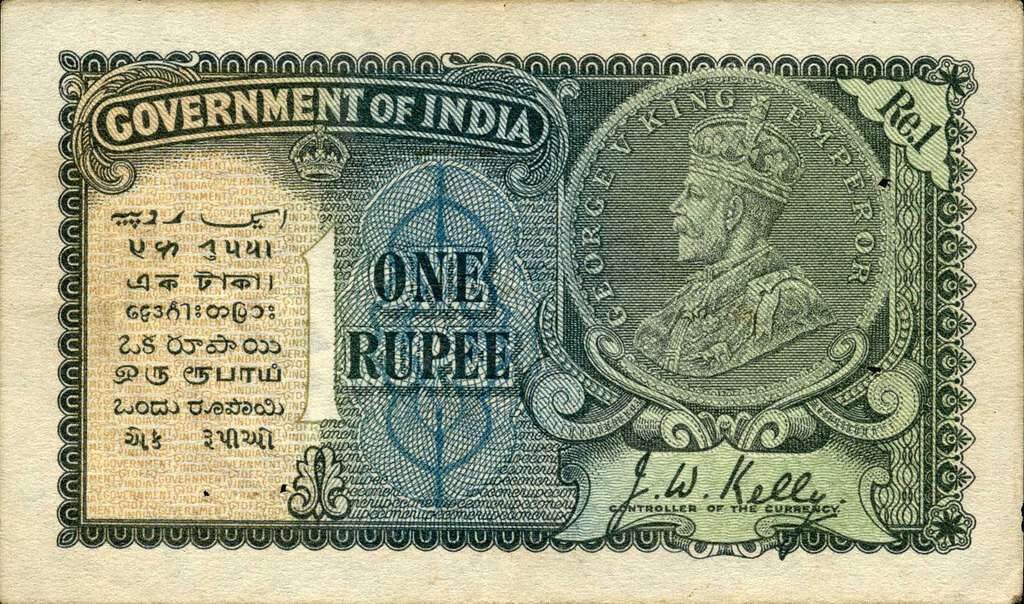
The first ₹1 note was not merely a smaller version of an ordinary banknote. It emerged from the practical need to substitute paper for the metallic rupee during wartime. That origin would eventually help give the denomination its unusual legal identity.
The note carried a promise to pay the bearer the sum of one rupee — a striking reminder that paper was standing in for the rupee itself.
1926 — The ₹1 Note Vanishes
The First World War ended in 1918. As conditions changed, the economics of small-denomination paper currency changed with them.
On 1 January 1926, issuance of the ₹1 note was discontinued on cost-benefit considerations. After fewer than nine years of issuance, the paper rupee disappeared.
For roughly fourteen years, no new ₹1 paper notes were issued. It might have remained a short-lived wartime experiment — but circumstances changed again.
1935 — India Gets a Central Bank
On 1 April 1935, the Reserve Bank of India began operations. The RBI became responsible for issuing India's regular banknotes, and its own banknotes began appearing in 1938.
So when the ₹1 note returned, one might naturally expect it to return as an RBI note. It did not. That decision is the key to the entire story.
1940 — Another World War Brings It Back
The Second World War began in 1939. Once again, wartime conditions created pressure on metallic currency. In August 1940, the one-rupee note was reintroduced as a wartime measure.
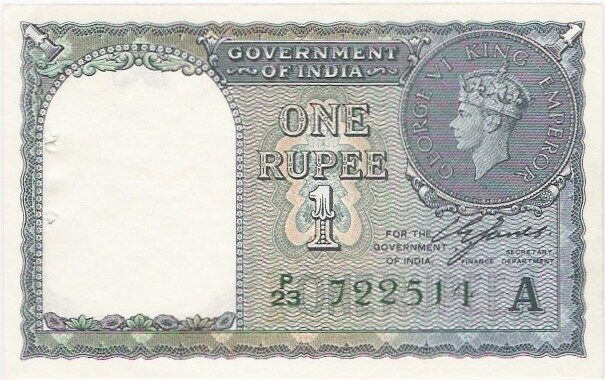
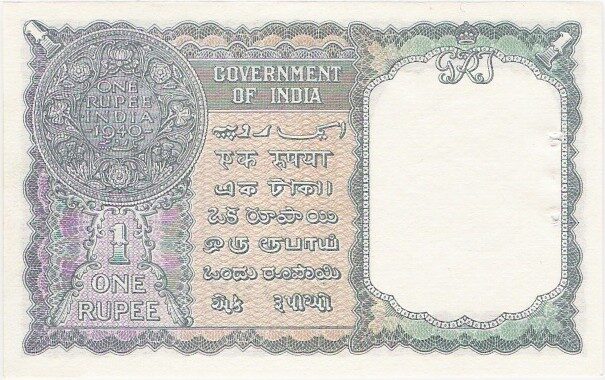
This time something crucial had changed: the RBI already existed. Yet the ₹1 note was still issued by the Government of India, not by the Reserve Bank.
Under the wartime arrangement, the paper ₹1 was given the status of a rupee coin. That seemingly technical choice created the institutional distinction that still makes the denomination unique.
The Note That Is Legally Like a Coin
Take an ordinary Indian banknote and you will see "RESERVE BANK OF INDIA" and the signature of the RBI Governor. Now look at a ₹1 note: it says "GOVERNMENT OF INDIA" and carries the signature associated with the Government's Finance Ministry.
The reason is legal as well as historical. The one-rupee note is included within the expression "rupee coin" for the purposes of the RBI framework. Rupee coins are liabilities of the Government of India; therefore the ₹1 note is also a Government liability.
| Currency | Issuer / Signature |
|---|---|
| ₹1 coin | Government of India |
| ₹1 note | Government of India / Finance Ministry |
| ₹2 and higher banknotes | Reserve Bank of India / RBI Governor |
A useful way to think about the ₹1 note is: a coin printed on paper.
1947–1949 — The Empire Ends, the King Disappears
India became independent on 15 August 1947. Currency could not be redesigned overnight, so existing designs continued during the transition.
In 1949, the Government of India introduced a new-design ₹1 note for independent India.
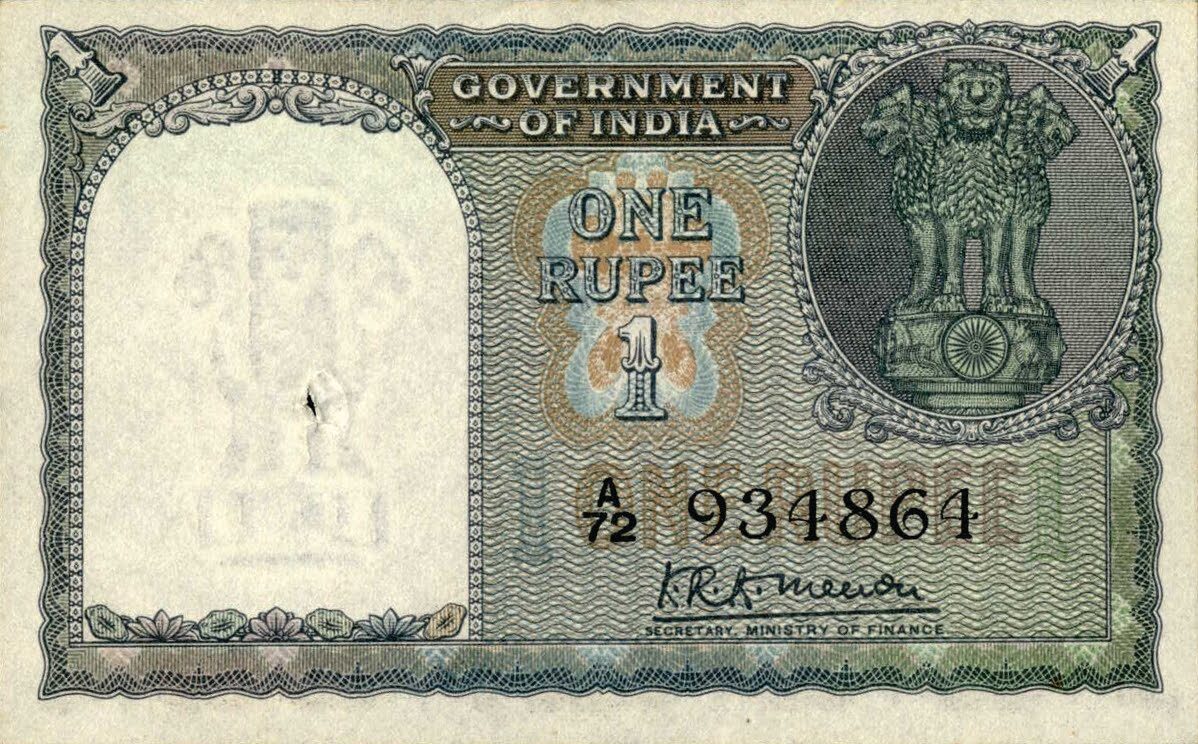
The transformation was symbolic. The King disappeared and the Lion Capital of Ashoka represented the new nation. Yet one important feature remained unchanged: the ₹1 note was still a Government of India issue rather than an RBI banknote.
Empire → Independence · King → Ashoka · British India → India
The Signatures Become a History of India
For collectors, this distinction creates an unusually rich series. Ordinary Indian banknotes are often classified by RBI Governor signatures. The ₹1 note follows a different lineage: its signatures are connected with the Government of India's Finance Ministry.
Arrange ₹1 notes chronologically and the collection becomes more than a set of paper-money varieties. It becomes a miniature record of changing officials, governments, economic eras, designs, prefixes and printing varieties.
This is one reason a comprehensive ₹1 signature set can be so rewarding: the smallest denomination becomes a long-running administrative and monetary timeline of India.
1994 — The ₹1 Note Disappears Again
By the late twentieth century, inflation and production economics had once again caught up with the smallest paper denomination. A paper note wears out relatively quickly, while a metal coin can remain in circulation much longer.
The Government of India continued issuing one-rupee notes until 1994, when printing was discontinued. For more than two decades afterward, the paper rupee became something many Indians encountered more often in collections than in everyday transactions.
2015 — The ₹1 Note Returns
Then the ₹1 note surprised everyone again. In 2015, more than twenty years after printing had stopped, the Government of India revived the denomination.
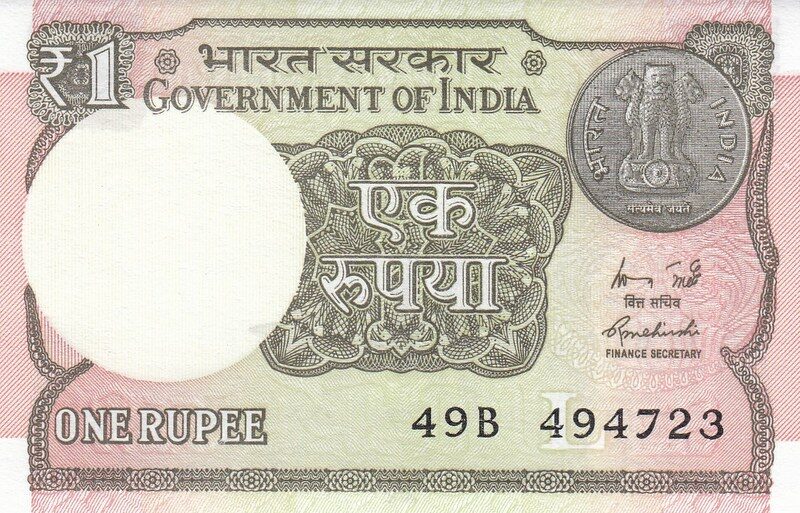
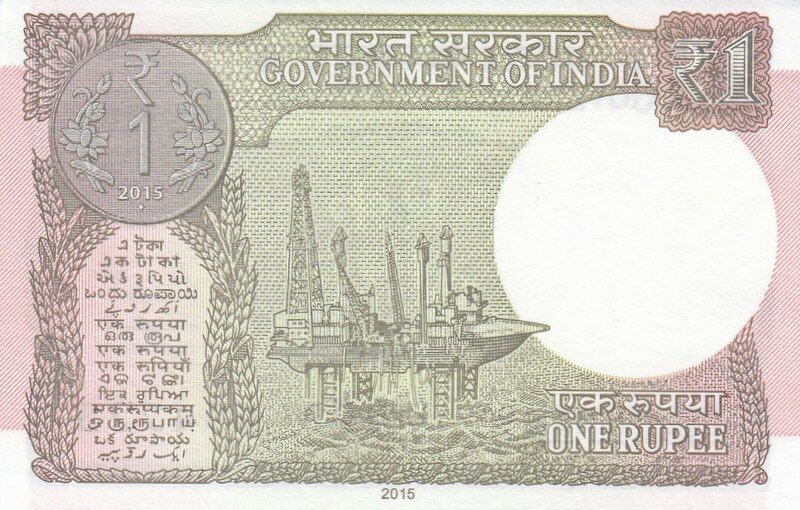
Nearly a century had passed since the first paper rupee appeared in 1917. Yet the institutional identity of the note remained unmistakable: it still said "Government of India," it was still a Government liability, and it still was not signed by the RBI Governor.
Modern designs also continue the visual connection with coinage by depicting the contemporary one-rupee coin on the note itself — an elegant reminder of the denomination's unusual legal ancestry.
One Small Note. More Than a Century of History.
- 1917 — World War I leads to the introduction of the ₹1 paper note.
- 1926 — Issuance is discontinued on cost-benefit considerations.
- 1935 — The Reserve Bank of India begins operations.
- 1940 — World War II brings the ₹1 note back as a Government note with the status of a rupee coin.
- 1949 — Independent India introduces its new ₹1 design; the King gives way to the Lion Capital of Ashoka.
- 1994 — Government of India stops issuing new ₹1 notes.
- 2015 — The ₹1 note returns after more than two decades.
From a Silver Rupee to a Collector's Treasure
Few people looking at a ₹1 note today would imagine how much history is contained within that tiny piece of paper.
Its ancestors were silver coins. Its first appearance came during the First World War. It disappeared. A second World War brought it back. It survived the creation of the Reserve Bank of India without becoming an RBI note. It witnessed the end of British rule. The portrait of a King gave way to the Lion Capital of Ashoka. Generations of Indian financial administrators placed their signatures upon it. It disappeared for more than twenty years — and then it returned.
Its purchasing power may have become tiny. Its historical significance has not.
India's smallest note carries one of the biggest stories in Indian currency.
Collector's Curiosity
Why doesn't the RBI Governor sign the ₹1 note?
Because the ₹1 note is issued by the Government of India rather than the Reserve Bank of India. Its unusual position traces back to the rupee's history as a coin and to the special legal status attached to the paper ₹1 when it was reintroduced during the Second World War.
That tiny signature difference tells a story more than a century old.
Sources
- Reserve Bank of India, Museum — British India Issues: introduction of the ₹1 note on 30 November 1917; discontinuation on 1 January 1926; wartime reintroduction in August 1940.
- Reserve Bank of India, India Paper Money: A Retrospect: Government of India issuance of the ₹1 note with the status of a coin; continued Government issuance until 1994.
- Reserve Bank of India, Museum — Republic India Issues: Government of India's new-design ₹1 note in 1949.
- Reserve Bank of India, Frequently Asked Questions: the ₹1 note is a Government of India liability and is included in the expression "rupee coin" for the relevant legal framework.
Image Credits
| Note | Source | License / Link |
|---|---|---|
| 1917 (H. Denning), combined | Government of India, via Wikimedia Commons | Public domain — commons.wikimedia.org/.../IND-1c-Government_of_India-1_Rupee_(1917).jpg |
| 1917 variant (J. W. Kelly) | Via Wikimedia Commons / Picryl | Public domain — [add exact Commons file URL — unconfirmed] |
| 1940 wartime, obverse (George VI) | Via Wikimedia Commons | Public domain — commons.wikimedia.org/.../KGVI_rupee_1_note_obverse.jpg |
| 1940 wartime, reverse (George VI) | Via Wikimedia Commons | Public domain — [add exact Commons file URL — unconfirmed] |
| 1949 Independence (K. R. K. Menon) | Government of India, via Wikimedia Commons | Public domain — commons.wikimedia.org/.../First_banknote_of_independent_India,_one_rupee,_1949.jpg |
| 2015 revival, obverse (Rajiv Mehrishi) | Reserve Bank of India, via Wikimedia Commons | GODL-India — [add exact Commons file URL — unconfirmed] |
| 2015 revival, reverse | Reserve Bank of India, via Wikimedia Commons | GODL-India — [add exact Commons file URL — unconfirmed] |
.jpg)


Editorial note: three images (the 1917 signature variant, and both sides of the 2015 note) and the reverse of the 1940 note still need their exact Commons file-page links confirmed — the bracketed items above. GODL-India in particular requires the source URL as part of a valid attribution statement.